• Welcome to our Product Safety & STC Forum

    A dynamic community dedicated to sharing knowledge and fostering discussions on all aspects of food and related products safety. Here, you can connect with experts and enthusiasts alike to exchange ideas, ask questions, and find valuable insights on maintaining the highest standards in food safety practices. While our forum is a great place for initial advice and information, more comprehensive guidance is available through our specialised training programs and our expert sister consultancy services, QTC. We invite you to explore the wealth of resources and expertise that our community and professional services have to offer.


What’s your approach to managing and documenting supplier assurance for small or artisanal producers with limited technical documentation?

  • Thread starter Thread starter Sam
  • Start date Start date
S

Sam

New member
Joined
Aug 6, 2025
Messages
4
Points
3
Many companies source from small-scale suppliers, but ensuring they meet technical or audit requirements (like BRCGS or GFSI) can be tricky.
 
Hi Sam, my approach would be to find a reputable advisor for the business who could come in and assist on an ad-hoc basis to provide the knowledge and service they need. This would be a cheaper option than looking for full-time support, but would ensure that they can meet the standards required.
 
Great question and @Steph is quite right that advisors / consultants can always support, since the question specifically states that we're talking about small businesses here. If we're talking about a typical certified business being the customer and the artisan supplier of raw material / ingredients being the supplier, then we are typically looking for the 3 options of supplier approval:
  1. the supplier has GFSI certification - definitely not the case when (as Sam states), they have limited technical docs.
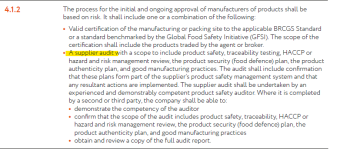
  2. the supplier has been audited (non GFSI 3rd party audit or the buyer has audited them. This is again a solution - it's unlikely they have any certification but the buyer can absolutely conduct the audit if the auditor is trained and competent and this can provide great assurance of the suppliers manufacturing skills in creating a good, safe and legal product.
  3. where an audit isn't practical or feasible, maybe due to distance (although we always advise that a remote audit is better than just a questionnaire), then there's the questionnaire approach that is very common and not an issue at all - as long as...
  • the supplier and the product in question is low risk (risk assessment needed here)
  • the questionnaire is comprehensive
  • the completed questionnaire is assessed by a trained and competent person
I really don't think that we want to say no to doing business with local suppliers who have fantastic creative skills in making beautiful product. It only takes a little effort in getting those documented assurances in place to be able to approve them.
 
'where an audit isn't practical or feasible, maybe due to distance (although we always advise that a remote audit is better than just a questionnaire), then there's the questionnaire approach that is very common and not an issue at all - as long as...
  • the supplier and the product in question is low risk (risk assessment needed here)'

1. How is the risk assessment done for products? We only sell textiles. In comparison to food, our textiles are low risk products. But If I compare basic Tshirts to UV-protection swimwear I would evaluate the UV-protectio clothing as higher risk product. So what does the BRCGS (Agents & Brokers) want me to compare in my product risk analysis? Or are textiles (clothing and hometextiles) generally classified as low-risk products?

2. For non-food products assessed as low-risk the BRCGS Agents&Brokers also gives the option to use a 'legally enforcable contract/specification from the supplier' as supplier approval. Does it mean a contract would be enough? There are no requirements what the contact must inculde?
 
Hi @Laura thanks for your question - you won't be the only one wondering how to go about this.
BRC's agents and broker standard is pretty flexible on this because they are quite practical. They know that when you need to buy and sell products, you need to be able to function as a business. BRCGS is giving us deliberate flexibility on this point.

A contract is simply an agreement that's enforceable, right? Even if that's an online purchase then it's all the details supporting that online purchase. Just as an example I say I talk about online purchase because this is the way the world works now. Although there is no definition in the glossary for contract, the clause is giving us the other option of specification, as you rightly pointed to. The glossary says this about a specification: An explicit or detailed description of a material, product or service. Again whether you purchase via an email quote, which gives you all the necessary information you need about the material, or whether you make an online purchase and the product listing gives you all the information you need to ensure that you get the product you thought you were going to get, then that clause is covered.

To answer your question more specifically, what a contract or specification must include is enough information for you to be satisfied that you're going to get what you need. If you don't, you can go back to the supplier and complain. I bet you can imagine how very different this would be for a paper clip versus a mobile phone and that's why BRCGS can't be specific. They're happy to give you flexibility so you can apply your expertise here. Your example of the UV-protection clothing is perfectly demonstrating your expertise. Apply that in a simple document showing what you believe to be low vs high risk items or properties of those items and the auditor is going to be happy. They know that sites are the experts and it's only where they see a risk that the site hasn't addressed that a non-conformity is then a possibility.

Last point to make here, clause 3.7.4 in the A&B standard even allows for a historical trading relationship (again, only for something you have assessed as low risk). I like this, very practical. If you've been buying those Tshirts from your supplier for a few years and everyone is happy with the product and the service, why change anything. Just pop that in your risk assessment and Voilà.
 
Back
Top